17.12.2024
DIGITAL WORLD
What is SEO? How is SEO done?
SEO stands for Search Engine Optimization.
The theory, which explains how investors make decisions when faced with risk and uncertainty, forms the foundation of finance. Prospect theory was first developed by Victor Vroom in 1964 and is widely accepted as one of the most prominent motivation theories. In the 1970s, Kahneman and Tversky presented the prospect theory as a choice model in their joint study.
Despite numerous criticisms, much evidence supports this theory. At its core, the theory involves a cognitive process that examines how individuals choose between different motivational elements.
Tversky and Kahneman argued that the pain caused by a loss is nearly twice as intense as the pleasure derived from an equivalent gain. As a result, they proposed that people's choices are influenced by a ‘‘loss aversion’’ tendency.
In the theory, the tendency to exhibit a particular behavior is linked to the attractiveness of the behavior’s outcomes and the strength of expectations regarding those outcomes. Simply put, if individuals believe that their efforts will result in a positive performance evaluation, they are more likely to exert a high level of effort. This evaluation should lead to rewards, such as bonuses, salary increases, or promotions, which must satisfy individuals' personal goals. Employees who have high expectations of receiving valuable rewards tend to demonstrate higher performance to increase their chances of achieving them.
The theory suggests that when individuals pursue their goals, they may ask themselves the following questions:
In businesses, there is an effort-performance relationship, and these relationships are listed as follows from a business perspective:
Prospect theory has also been used in the field of "social sciences." Social sciences examine the human and social dimensions of the world and life we live in. This shows that the theory is related to social sciences through its examination of behaviors that investors/employees engage in due to the risks they take. The fundamental principle is to reveal people's effort characteristics through assigned tasks. The theory also helps managers create motivation programs or seminars.
In other words, from a social sciences perspective, the pain that arises from people's loss is almost twice the pleasure they would feel from the same amount of gain, or expecting a reward, bonus, or promotion due to the risk taken in a different task explains these behaviors from a social sciences perspective.
Employees need to show a greater tendency to demonstrate how meeting or exceeding expectations will lead to their desired rewards. This theory also increases not only the employees' productivity and performance but also the business's productivity and performance.
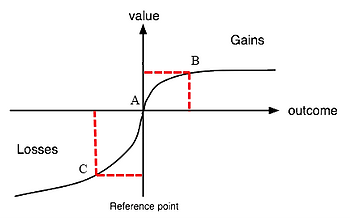
For example, considering the graph shown: the pleasure of gaining $50 is less than the pain of losing $50. This graph represents the difference between pain and pleasure resulting from gains and losses. Events can be evaluated differently from each other.
For a more explanatory example: if you find $50 and then lose it, even though there is no net change in wealth, you may feel disappointed. The reason is that the amount of joy you get when finding the money is overshadowed by the amount of pain you feel when losing it. As a result, there is a net loss of utility.
First, Prospect theory was developed by Victor Vroom in 1964 and has emerged as the most widely accepted motivation theory. It is known as the Prospect theory based on the premise that if an employee believes their efforts will result in outcomes and their expectations will be met in return, they will tend to maintain high performance and have high motivation tendency to show greater effort.
This theory was presented in a joint study by Kahneman and Tversky in the 1970s. While there are many criticisms against this theory, there appears to be evidence supporting it. The pleasure of gaining $50 being less than the pain of losing $50 is an example that creates the pleasure/pain graph and serves as a relevant example from a social sciences perspective. Generally speaking, the theory itself is also connected from a social sciences perspective.
In businesses, there is an effort-performance relationship, and these relationships are listed from a business perspective.
The relationship between performance and evaluation, with high effort and receiving rewards in return, and these rewards being at a level that can satisfy personal goals. Therefore, from a social sciences perspective, it shows that the theory is related to social sciences through its examination of behaviors that investors/employees engage in due to the risks they take.

Although Prospect theory in business doesn't include the motivational needs of each employee, the theory helps managers create motivation programs or seminars. The key meaning in the theory process is effort and performance.
An employee with high expectations for a valuable reward tends to have high performance to increase their own performance. For managers to benefit from Prospect theory, they need to show their employees the connection between their efforts and performance expectations, and then tend to demonstrate more how meeting or exceeding expectations will lead to the rewards desired by the employee.
In conclusion, a person's motivation consists of a combination of their expectation of reaching their goal and the value they place on that goal.
If you're interested in this content, we recommend checking out our other blog posts on similar topics. You can find more content here.
#Fiyuva, #EconomyFeatured Blogs
SEO stands for Search Engine Optimization.
Start-up is a concept used by entrepreneurs.
To understand content marketing, it's first necessary to grasp the meaning of the words 'content' and 'marketing' and establish the connection between.
You need to be aware of the statistical data your site obtains.